

Long before Bali became a magnet for surfers and wellness seekers, it was — and still is — an island shaped by the hands of its artisans. Scattered across the highlands and villages surrounding Ubud, entire communities have specialised in a single craft for generations: wood carving in Mas, silverwork in Celuk, weaving in Tenganan, and painting in Batuan. Visiting these villages offers something deeper than souvenir shopping. It’s a window into a value system where art, spirituality, and daily life are inseparable, and where patience is treated as a skill in its own right. Here’s what travellers can genuinely take away from spending time with Bali’s craft communities.
- Mas: The Village of Wood Carvers
- Celuk: Generations of Silver and Gold
- Tenganan: The Double Ikat Weavers
- Batuan and Ubud: Painting as Spiritual Record-Keeping
- Batubulan: Stone Carving and Barong Performances
- The Deeper Takeaway: Community Over Individual Achievement
- How to Visit These Communities Responsibly
Mas: The Village of Wood Carvers
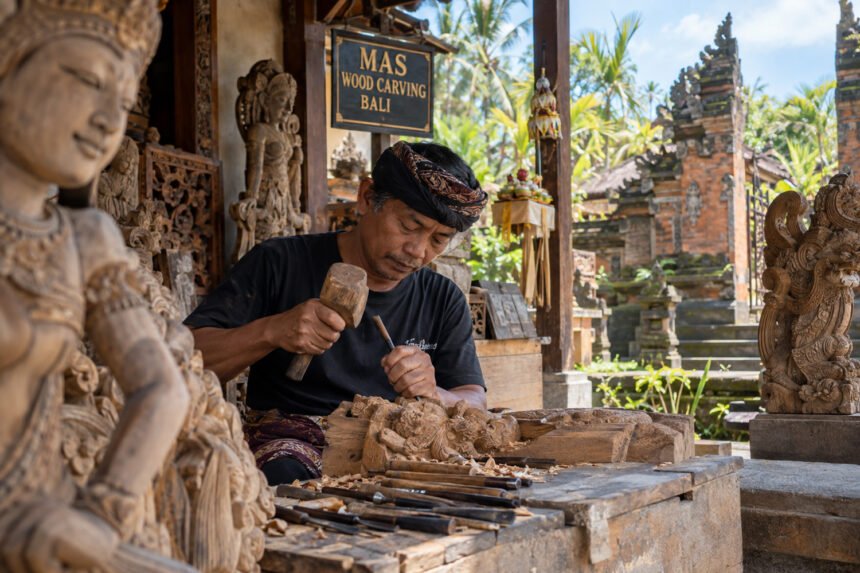
Mas has been synonymous with wood carving for centuries, and walking its main road reveals workshop after workshop filled with statues, masks, and furniture in various stages of completion. Traditionally, carvers worked exclusively in sacred woods like belalu and jackfruit, believing the material itself carried spiritual weight. Many pieces produced here aren’t decorative at all — they’re ceremonial masks used in Topeng dance performances or temple guardian figures meant to ward off negative energy. Watching a carver work is a lesson in unhurried precision: a single mask can take days, with no shortcuts taken for the sake of speed.
Lesson for travellers: Craftsmanship rooted in purpose, rather than volume, produces work that lasts. It’s a reminder that speed and quality are rarely the same goal.
Celuk: Generations of Silver and Gold
Celuk’s silversmiths trace their trade back to royal commissions for temple ceremonial items and jewellery worn during Balinese Hindu rituals. Family-run workshops still dominate the village, with skills passed from parent to child rather than taught in formal schools. Visitors can watch artisans hand-hammer intricate filigree patterns using techniques that predate modern tools, often producing pieces so fine they resemble lace cast in metal.
Lesson for travellers: In a culture that prizes lineage and continuity, craft isn’t just a job — it’s an inheritance. Many silversmiths in Celuk can trace their technique back through four or five generations of the same family.
Tenganan: The Double Ikat Weavers
Tenganan Pegringsingan, one of Bali’s oldest Bali Aga (original Balinese) villages, is home to one of only three places in the world that still produces geringsing — a rare double ikat textile where both the warp and weft threads are dyed before weaving. The process is so labour-intensive that a single cloth can take two to five years to complete, and the textiles are believed to hold protective spiritual properties, used in rites of passage from birth to death.
Lesson for travellers: Some traditions resist modernisation entirely, not out of stubbornness but because the process itself is considered sacred. Efficiency isn’t always the goal — meaning is.
Batuan and Ubud: Painting as Spiritual Record-Keeping
The village of Batuan developed a distinctive painting style characterised by dense, dark compositions filled with layered scenes from Hindu mythology, daily village life, and the spirit world coexisting in a single frame. Unlike the brighter, tourist-friendly Ubud style that emerged later, Batuan paintings were traditionally created to decorate temples and record cosmology rather than to be sold. Many working studios still welcome visitors to observe the meticulous ink-and-brush technique passed down through generations of local families.
Lesson for travellers: Art doesn’t always exist to be admired from a distance. In Balinese tradition, paintings often served as functional, spiritual documents — a reminder that creative work can carry responsibility as well as beauty.
Batubulan: Stone Carving and Barong Performances
Batubulan is known for two things: intricate stone carvings made from soft volcanic paras stone, and being one of the main villages performing the Barong dance, a ritual battle between good and evil spirits. The stone carvings — guardian statues, temple gates, and mythological figures — are made using techniques suited to the material’s softness, allowing for extraordinarily fine detail that hardens over time as the stone is exposed to air.
Lesson for travellers: Adaptation to local materials, rather than fighting against them, often produces the most distinctive results. Balinese artisans have long shaped their techniques around what the island itself provides.
The Deeper Takeaway: Community Over Individual Achievement
Perhaps the most valuable lesson from Bali’s craft villages isn’t found in any single technique — it’s in the structure of the communities themselves. Many villages operate on a banjar system, a local community council that organises everything from temple ceremonies to craft cooperatives. Artisans often work collectively, sharing tools, training apprentices for free, and pricing work in ways that support the whole village rather than maximising individual profit. For travellers from more individualistic cultures, this is often the most striking realisation: mastery here is inseparable from community obligation.
How to Visit These Communities Responsibly
- Buy directly from workshops rather than resellers, ensuring more of your money reaches the artisans themselves.
- Ask before photographing artisans at work; many are happy to explain their craft but appreciate being asked first.
- Avoid aggressive bargaining on handmade pieces — prices often reflect weeks or months of skilled labour, not mass production costs.
- Consider a workshop class, many villages now offer short hands-on sessions in carving, weaving, or silverwork for curious visitors.
- Visit during a ceremony if invited, as craft and ritual are deeply connected; seeing a mask or textile used in its intended context adds meaning that a shop display cannot.