

Bali’s culture is inseparable from its religion, and understanding even a few core customs can transform a visit from simple sightseeing into something far more meaningful. Unlike much of Muslim-majority Indonesia, Bali practises a distinct form of Hinduism woven with animist and ancestral beliefs, expressed daily through offerings, ceremonies, and a deep sense of spiritual balance. For travellers, respecting these customs isn’t just about etiquette — it’s about recognising that you’re a guest in a living, deeply spiritual culture. Here’s what every visitor should understand before arriving.
- The Philosophy of Tri Hita Karana
- Canang Sari: The Daily Offerings
- Temple Etiquette: What to Wear and How to Behave
- Understanding Nyepi: The Day of Silence
- The Significance of the Head and Left Hand
- Greetings and Everyday Social Etiquette
- Ceremonies and Processions
- Dress and Behaviour Beyond Temples
- Why These Customs Matter for Travellers
The Philosophy of Tri Hita Karana
At the heart of Balinese culture sits Tri Hita Karana, a philosophy describing three sources of harmony: between people and God, between people and each other, and between people and nature. This principle shapes nearly everything visible on the island, from the layout of temples to the design of rice terrace irrigation systems. Understanding this concept gives context to behaviours that might otherwise seem confusing to outsiders — such as why locals maintain small offerings even in the busiest tourist areas, or why environmental and social harmony are treated as spiritual obligations rather than optional courtesies.
Canang Sari: The Daily Offerings
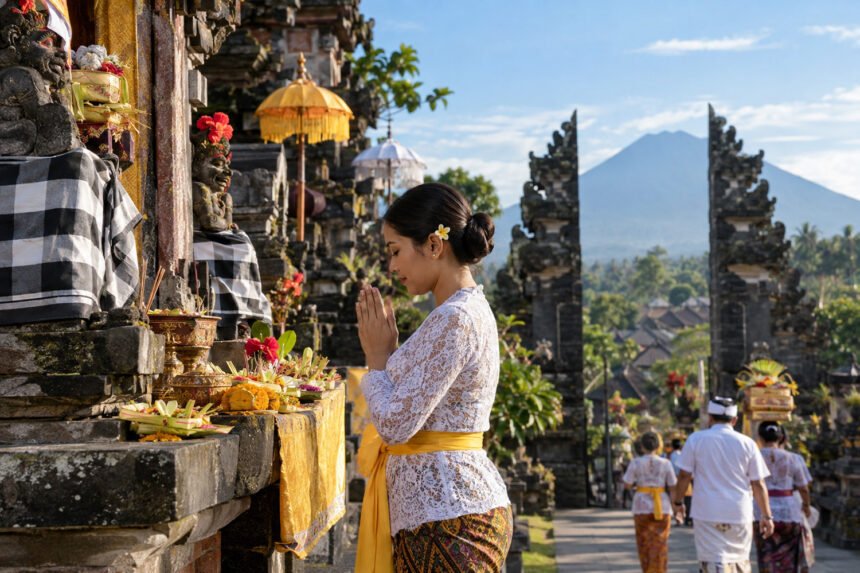
Perhaps the most visible custom in Bali is the canang sari, small woven palm-leaf trays filled with flowers, rice, and incense placed outside homes, shops, and temples multiple times a day. These offerings are gifts to the gods and spirits, meant to maintain balance and gratitude. Travellers should never step on, kick, or move a canang sari, even accidentally — doing so is considered deeply disrespectful, regardless of intent. Watching where you walk, particularly on sidewalks and shop entrances, becomes second nature after a day or two on the island.
Temple Etiquette: What to Wear and How to Behave
Visiting a Balinese temple requires specific dress and conduct:
- A sarong and sash (selendang) must be worn around the waist, typically available for rent or loan at temple entrances.
- Shoulders should be covered, and overly revealing clothing is discouraged even outside temple grounds in more traditional areas.
- Menstruating women are traditionally asked not to enter temple inner sanctums, a custom rooted in specific beliefs about spiritual purity rather than any negative judgement — it’s worth respecting this request even if it feels unfamiliar.
- Never climb on shrines or statues for photographs, and always ask before photographing people during active prayer or ceremony.
- Keep your head lower than any priest’s head during a blessing ceremony, as the head is considered spiritually significant (more on this below).
Understanding Nyepi: The Day of Silence
Nyepi, the Balinese New Year, is unlike any other holiday most travellers will encounter. For 24 hours, the entire island — including the airport — shuts down. No lights, no travel, no loud noise, and no work are permitted, even for tourists confined to their hotels. The custom is rooted in the belief that evil spirits, tricked into thinking the island is uninhabited, will pass over and leave Bali in peace for the coming year. Travellers visiting during this period should plan carefully, as flights and normal activities pause entirely, but many find the enforced stillness a uniquely memorable, almost meditative experience.
The Significance of the Head and Left Hand
Two physical customs surprise many first-time visitors. First, the head is considered the most sacred part of the body in Balinese belief, as it’s closest to the divine. Touching someone’s head, even a child’s in an affectionate gesture, is considered inappropriate and should be avoided. Second, the left hand is traditionally associated with impurity and is not used for giving or receiving items, eating, or pointing at people or sacred objects. Using the right hand, or both hands together for something like a gift, is the respectful default.
Greetings and Everyday Social Etiquette
Balinese social interactions tend to favour warmth, patience, and indirectness over bluntness. A raised voice or visible frustration, even when a situation genuinely warrants it, is seen as a loss of composure and can damage rapport rather than resolve an issue. Smiling, remaining calm, and allowing space for conversation — even simple transactions — tends to produce better outcomes than rushing. Many Balinese people also use a traditional naming system based on birth order (Wayan, Made, Nyoman, Ketut, repeating for additional children), which explains why these names appear so frequently across the island.
Ceremonies and Processions
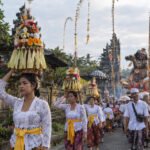
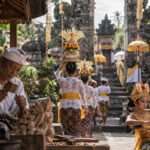
It’s common to encounter a religious procession, cremation ceremony, or temple festival unexpectedly while travelling around Bali. Roads may close temporarily, traffic may be redirected, and locals dressed in ceremonial white and gold will often be seen carrying offerings toward a temple. Rather than treating this as an inconvenience, travellers are encouraged to pause, observe respectfully from a distance, and avoid walking through an active procession. Being invited to witness or even participate in a ceremony is considered an honour, and dressing modestly with a sarong on hand makes spontaneous participation possible.
Dress and Behaviour Beyond Temples
While beach areas and tourist hubs have relaxed considerably around Western clothing norms, more traditional inland villages still appreciate modest dress, particularly for women. Public displays of affection, while increasingly common in tourist zones, are still viewed as inappropriate in more conservative or rural communities. A general rule that serves travellers well: the further from beach resort areas you travel, the more conservative dress and behaviour should become.
Why These Customs Matter for Travellers
Respecting Balinese customs isn’t simply about avoiding offence — it reflects a broader recognition that tourism exists alongside, not above, a functioning spiritual culture. Balinese communities have opened their island to millions of visitors while maintaining daily religious practices largely unchanged for centuries. Travellers who take the time to understand even a handful of these customs tend to report deeper, more meaningful interactions with locals, who notice and appreciate the effort.