

Bali is often sold as a paradise of rice terraces, surf breaks, and infinity pools, but its deepest beauty lies somewhere quieter: in the smoke curling from a temple offering, the rhythm of a gamelan orchestra, and the hush that falls over the island during Nyepi. For travelers willing to look past the postcard images, Bali’s spiritual traditions offer something far more valuable than a good photo. They offer a way of thinking about balance, community, and gratitude that most visitors never expected to bring home. Here’s what the island’s sacred spaces and rituals can actually teach you.
- Temples as Lessons in Balance, Not Just Beauty
- Ceremonies: A Culture Built Around Community, Not the Individual
- Festivals Like Nyepi and Galungan: The Value of Deliberate Pause
- Tri Hita Karana: The Philosophy Behind the Practice
- Practical Lessons Visitors Can Actually Take Home
- Experiencing Bali’s Culture Respectfully
Temples as Lessons in Balance, Not Just Beauty
With more than twenty thousand temples scattered across the island, Bali sometimes feels like one continuous shrine. Every village has at least three: one facing the mountains, one at its center, and one facing the sea. This isn’t accidental architecture. It reflects a Balinese Hindu worldview in which the universe is held together by opposing but complementary forces — mountain and ocean, sacred and profane, order and chaos.
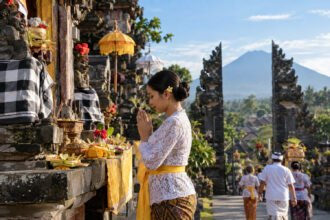
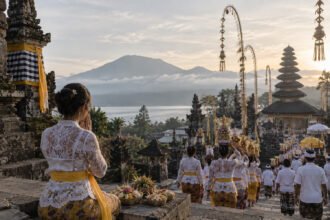
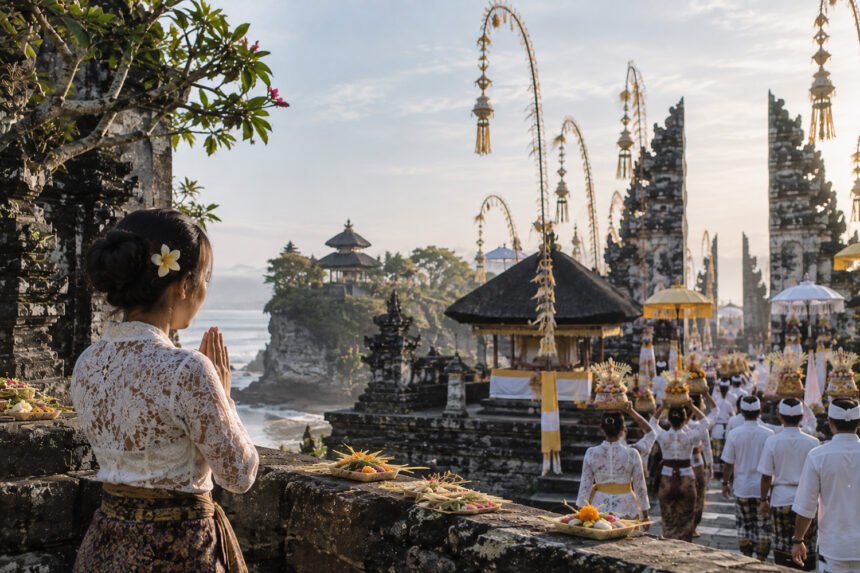
Visitors who walk through temples like Tanah Lot, Besakih, or Ulun Danu Beratan often notice this layered symbolism even without knowing the philosophy behind it. Courtyards are divided into outer, middle, and inner zones, each representing a different level of spiritual purity. The lesson here isn’t really about religion; it’s about structure. The Balinese remind us that balance isn’t something that happens by accident — it’s built deliberately, layer by layer, into daily life.
For a traveler juggling deadlines and notifications back home, this is a quietly radical idea: that your environment can be arranged, on purpose, to support inner calm rather than erode it.
Ceremonies: A Culture Built Around Community, Not the Individual
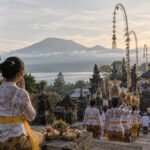
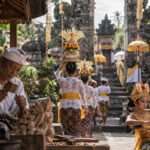
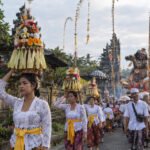
Spend even a few days in Bali and you’ll likely stumble into a ceremony — a tooth-filing ritual, a cremation procession, a temple anniversary known as an odalan. Streets close, entire villages turn out in white and gold, and life simply pauses to make room for ritual.
What strikes most visitors is not the spectacle but the participation. These aren’t performances staged for tourists; they are communal obligations everyone shares, from the youngest child carrying a small offering to the eldest elder leading a chant. Nobody seems to see this as inconvenient. It’s simply how the community affirms itself.
This is a useful mirror for visitors from more individualistic cultures. Balinese ceremonies suggest that a life built around showing up for others — repeatedly, ritually, without needing a “reason” — creates a kind of social resilience that’s hard to manufacture any other way. You don’t need to adopt Balinese Hinduism to notice that a community which practices togetherness often enough treats it as instinct, not effort.
Festivals Like Nyepi and Galungan: The Value of Deliberate Pause
If Bali has one lesson that visitors carry home more than any other, it’s the art of stopping. Nyepi, the Balinese Day of Silence, shuts the entire island down for twenty-four hours. No flights, no lights, no work, no sound. Tourists are confined to their hotels, and even the airport closes.
For a culture obsessed with productivity, watching an entire island choose stillness — deliberately, once a year — is almost disorienting. Nyepi isn’t imposed by scarcity or crisis; it’s a chosen reset, meant to allow reflection before the new Saka year begins. The night before, villages parade towering ogoh-ogoh effigies representing evil spirits, then symbolically burn them, clearing space for a clean start.
Galungan and Kuningan, celebrated roughly every six months, offer a gentler version of the same idea: a period to honor ancestors, express gratitude, and reconnect with family before returning to ordinary routines. Streets fill with penjor — tall, arched bamboo poles decorated with palm leaves and rice — symbolizing prosperity and thanks.
Together, these festivals teach a lesson that’s easy to admire and hard to practice: rest and reflection aren’t rewards you earn after work is done. They’re built into the rhythm of a healthy life, scheduled in advance, non-negotiable.
Tri Hita Karana: The Philosophy Behind the Practice
Much of what visitors observe in Bali traces back to a single guiding principle called Tri Hita Karana — “three causes of well-being.” It holds that harmony must exist in three relationships simultaneously: between people and God, between people and each other, and between people and nature.
This explains why temples, rice terraces, and village layouts all seem to follow similar logic. The subak irrigation system, a UNESCO-recognized network of water temples and canals, exists because farmers historically believed that managing water fairly and respectfully was a spiritual duty, not just a technical one.
For visitors, Tri Hita Karana offers a compact, portable philosophy: well-being isn’t only personal. It depends equally on your relationships with others and with your environment. Skipping any one of the three, Balinese tradition suggests, leaves the whole system out of balance — a framework that applies just as well to modern life as to rice farming.
Practical Lessons Visitors Can Actually Take Home
Beyond the philosophy, Bali’s rituals offer a few concrete habits worth borrowing:
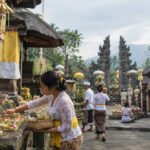
- Small daily gratitude rituals matter. The canang sari offerings placed on sidewalks and doorsteps each morning aren’t grand gestures — they’re small, repeated acts of thanks. Consistency, not scale, is the point.
- Community obligations build stronger bonds than convenience does. Showing up for others’ ceremonies, even when it’s inconvenient, strengthens social trust in ways that occasional grand gestures cannot.
- Scheduled stillness protects against burnout. You don’t need an island-wide shutdown; even a self-imposed weekly “quiet hour” can mimic Nyepi’s restorative function.
- Balance requires intention. Whether it’s temple architecture or a daily schedule, structure that separates the sacred from the mundane tends to create more peace than an unstructured life does.
Experiencing Bali’s Culture Respectfully
None of these lessons land well if they’re extracted carelessly. Visitors should dress modestly when entering temples (a sarong and sash are usually required and often provided), avoid stepping over offerings on the ground, and never treat a ceremony as a photo backdrop without first checking whether photography is welcome. Hiring a local guide, especially during major festivals, transforms a potentially awkward intrusion into a respectful, informative experience.
Respect, in other words, is the entry fee for actually learning something.